This gallery explores Newark's fascinating past, from Ice Age travellers to the Romans, Vikings and Anglo-Saxons.
Gallery highlights
Discover how these early communities shaped the town's roads, streets, castle and even the name Newark itself.
Here are a few highlights you can expect to see in the gallery. You can listen to an explanation from our experts for each piece on the Bloomberg Connects app under "Gallery Displays".
Image
Sherwood's Foresters drum
This drum belonged to the Sherwood Foresters, a local army regiment made up of soldiers from Nottinghamshire and Derbyshire. It’s believed to be the only drum from a Territorial Army battalion to survive service in World War I. It was presented to Colonel Charles Huskinson OBE, leader of the 8th Battalion, when the soldiers returned to Newark on 21st June 1919.
The Sherwood Foresters were part of the British Army from 1881 to 1970 and played an important role in both world wars.
Image
Lady Ossington's portrait
Painted in 1884 by Miss Hawkins, this portrait shows Viscountess Charlotte Denison, wife of John Denison, 1st Viscount Ossington and Speaker of the House of Commons. A strong supporter of the Temperance Movement, Lady Ossington built the Ossington Coffee Palace in Newark in 1882 to offer travellers a place to stay without the temptation of alcohol.
When the building’s alcohol ban ended in 1982, this painting gained a spooky reputation. It was found fallen from the wall at least three times, and some say it was Lady Ossington herself, unhappy that her wishes were no longer being followed!
Image
A roman skeleton
This lead coffin holds the skeleton of a Roman woman who lived near Brough, close to Newark. She was unusually tall for her time, about 173 cm (5 feet 8 inches), so tall that archaeologists first thought she was a man!
Coffins like this were used by wealthier Romans, and finding one helps us learn more about how people lived and were buried nearly 2,000 years ago.
Image
Folding parachute bike
Over 70,000 of these folding bikes were made during World War II. They were designed to be dropped from the air, either by glider, with their own small parachute, or carried by paratroopers – specially trained soldiers who bravely aimed to land behind enemy lines.
Many hated carrying the bikes, but they were useful for infantry soldiers, helping them move quickly once on the ground. The bike is displayed beside a side cap and jacket from the Polish parachute infantry brigade (on loan from the Sikorski Museum), recognising the vital role Polish pilots served as part of the Allied Forces throughout the war, first in France and then in Britain.
Image
Newark smock
Smocks were long, loose shirts worn by working men in the past. Many were cream-coloured and made from unbleached cotton or linen. Men often had one for everyday work and another for special occasions, like Sunday church or weddings.
Newark smocks are unusual because they’re blue, dyed with indigo or woad. This made them stand out from others and shows how local styles could be different across the country.
Image
Byron's printing press
This printing press was used by Samuel and John Ridge, who ran a printing business in Newark’s Market Place. It was most notably used for the printing of Nottinghamshire poet Lord Byron's early work. Byron’s first volume of verse, Fugitive Pieces, was printed on this printing press here in Newark in the summer of 1806.
Byron stayed here at the Clinton Arms. At this time, Byron was in love with a student, John Edleston. Edleston died in 1811, and Byron wrote a poem about his broken heart. Labelled “mad, bad and dangerous to know”, he is famous for love affairs with both women and men.
Image
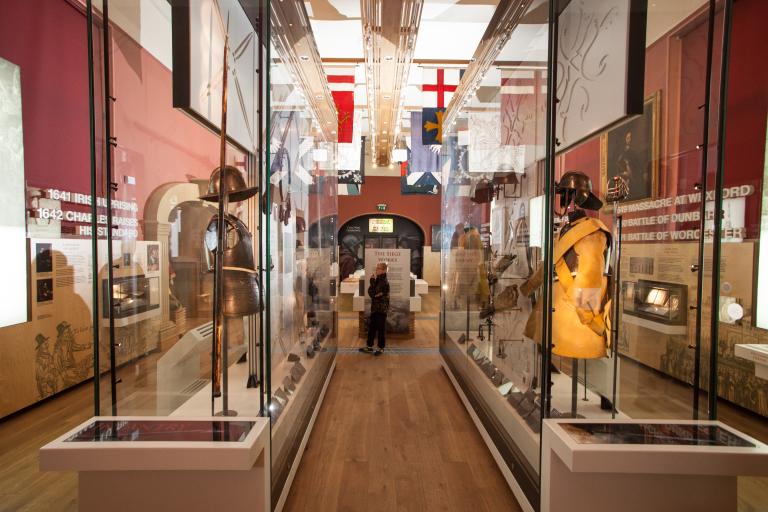
The Civil War Gallery
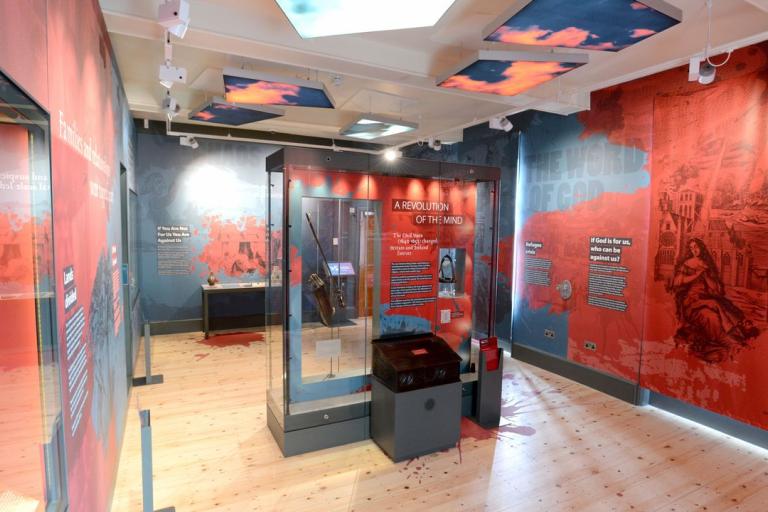
The Civil War Gallery explores how disagreements over power, politics, and religion led to a fight between Parliament and King Charles I, ending with the King’s trial and execution.
The Conflict Gallery shows the damage and unrest caused by the war, while the Creativity Gallery explores how the 1600s saw major changes in religion, science, culture, and politics.