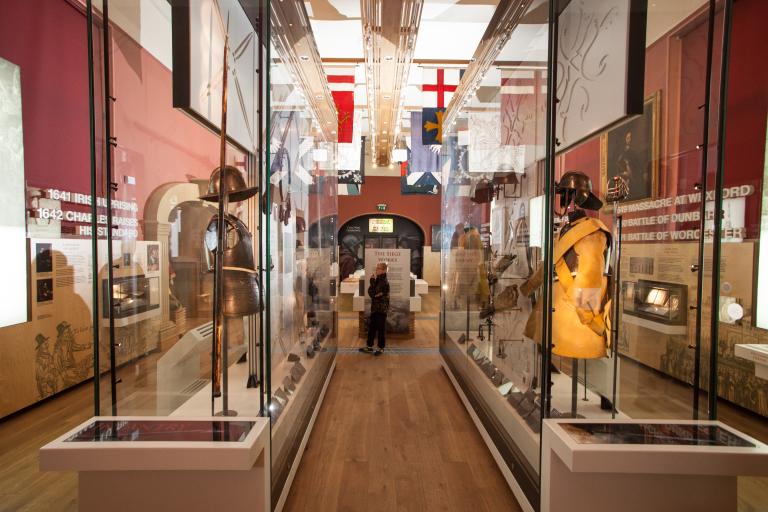
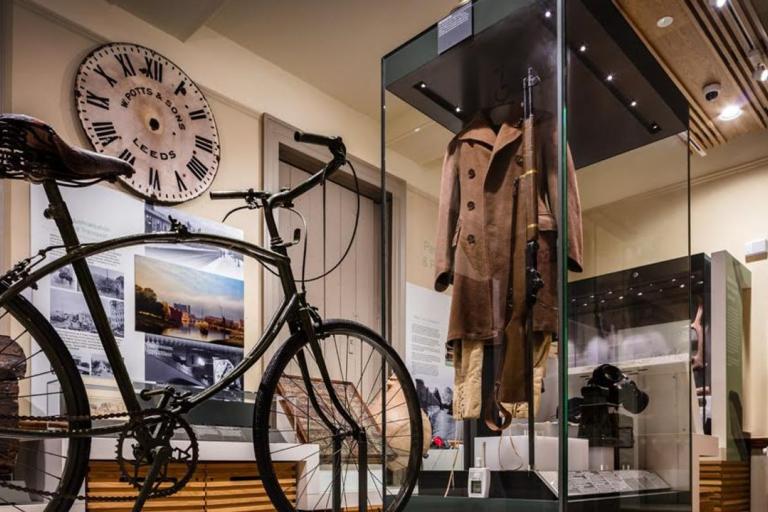
The Conflict Gallery shows the damage and unrest caused by the war, while the Creativity Gallery explores how the 1600s saw major changes in religion, science, culture, and politics.
Gallery highlights
The Civil War caused huge destruction, but it also led to big changes. After the fighting ended, people had a chance to rebuild society in new ways. The war’s chaos opened the door to fresh ideas and creativity.
Here are a few highlights you can expect to see in the gallery. You can listen to an explanation from our experts for each piece on the Bloomberg Connects app under "Gallery Displays".
Image
Siege map
This detailed map was made by the Royalists at the end of the third and final siege of Newark during the first Civil War. It shows the town and the surrounding siegeworks and is drawn on vellum (sheep skin). North is shown at the bottom left, which is different from modern maps. You can still recognise many of the streets today!
Look to the right to spot the Queen’s Sconce, a large earthwork fort where the Rivers Trent and Devon meet.
Image
Death mask
This is a cast of Oliver Cromwell’s face, made shortly after he died in 1658. Cromwell was a key figure in the English Civil War and later became Lord Protector of England. Death masks were used to preserve the features of important people.
Touch the face – can you feel any warts? Cromwell is often said to have told his portrait painter to show him 'warts and all', but this famous quote was probably made up. Still, this mask gives us a rare chance to see what he may really have looked like.
Image
Our 17th-century jukebox
Our 17th-century jukebox allows you to listen to music from the period – some of which is political, while others are love songs.
Image
Bullet extractor
This tool was used by surgeons during the 1600s to remove musket balls from wounded soldiers. After a battle, if a soldier was shot, the surgeon would use this tool to carefully probe the wound. The tip would be screwed into the soft lead of the musket ball, allowing it to be pulled out. It was a painful and risky procedure, especially without modern pain relief or clean conditions. Tools like this were essential for battlefield surgery during the British Civil War.
Image
Aphra Behn statue
This sculpture, created by artist Christine Charlesworth, celebrates Aphra Behn, one of the first women in Britain to earn a living as a writer. She also worked as a spy for King Charles II! Behn is remembered for breaking barriers in a time when women had few rights, and author Virginia Woolf praised her for giving all women 'the right to speak their minds'.
Image
Print explosion sculpture
This sculpture represents the explosion of print in the 1600s, when newspapers were published for the first time and printed booklets became more common and widely available. It includes examples of tracts, which were small pamphlets used to spread new ideas quickly across towns and cities.
These printed materials gave ordinary people access to information they’d never had before, helped spark debates, and allowed readers to explore the world in new ways during a time of exciting and sometimes dangerous change.
Image
The Civil War Gallery
The Civil War Gallery explores how disagreements over power, politics, and religion led to a fight between Parliament and King Charles I, ending with the King’s trial and execution